
What is an On-Grid Solar System?
An on-grid (grid-tied) solar system connects directly to your utility’s electrical grid — DEWA in Dubai, SEWA in Sharjah, or FEWA in the Northern Emirates. During the day, solar panels generate electricity that powers your property in real time. When the sun isn’t shining, you simply draw power from the grid as normal.
In Dubai and Abu Dhabi, excess solar energy is exported to the grid and credited back to your bill through net metering. In all other Emirates, systems run in zero-export mode — meaning all solar is consumed on-site, with no excess sent back to the grid.
This is the simplest, most affordable solar solution — and for properties with high daytime energy usage, it delivers the fastest return on investment.
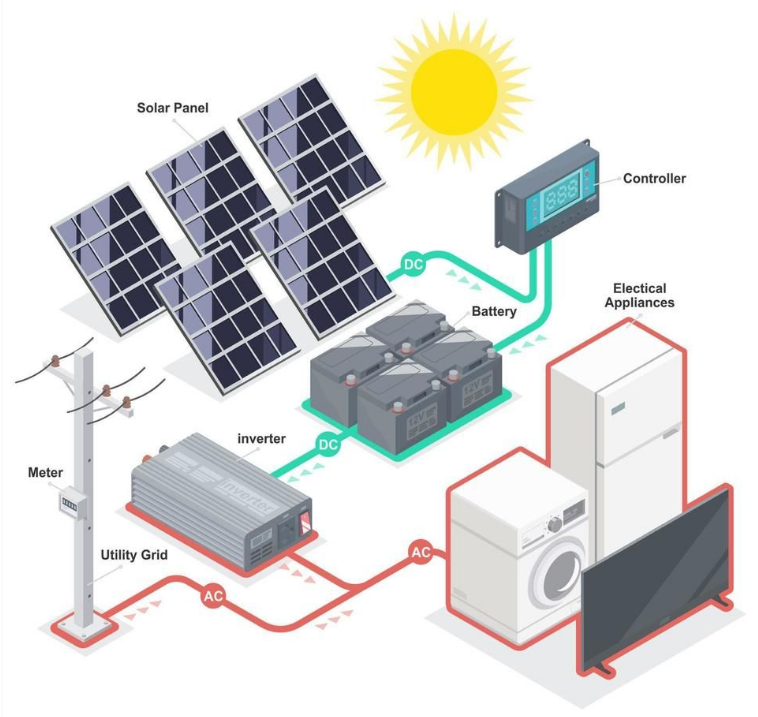

How It Works
Net Metering (Dubai / Abu Dhabi)
Solar powers your property during the day → excess exported to grid → credits accumulate → credits offset your evening/night consumption → your monthly bill shows total consumption minus solar credits.
Zero-Export (Sharjah, Ajman, RAK, Fujairah, UAQ)
Solar powers your property during the day → if production exceeds consumption, the inverter automatically reduces output → nothing is sent to the grid → at night, you draw from the grid as normal.
How Zero-Export Works (Only For Northern Emirates)
Zero-export is controlled by a combination of your inverter and a set of Current Transformers (CTs).
CT sensors are clamped onto your main supply cable at the meter/DB board. They continuously measure how much electricity your property is drawing from the grid in real time — sending this data to the inverter every fraction of a second.
The Inverter's Role
Using the CT data, the inverter dynamically adjusts its output to match your property’s exact consumption at any given moment. If your property is using 5 kW, the inverter outputs exactly 5 kW. If consumption drops to 3 kW, the inverter reduces output to 3 kW. Export stays at 0 kW at all times.
What Meter is Used?
In zero-export Emirates, your existing standard utility meter remains in place — no meter replacement or utility approval is required. The CT sensors and inverter handle everything independently, without any changes to the grid connection.
This is why zero-export systems in Sharjah, Ajman, RAK, Fujairah, and UAQ require no FEWA/SEWA pre-approval — the system is entirely self-regulating and never interacts with the grid beyond normal consumption.
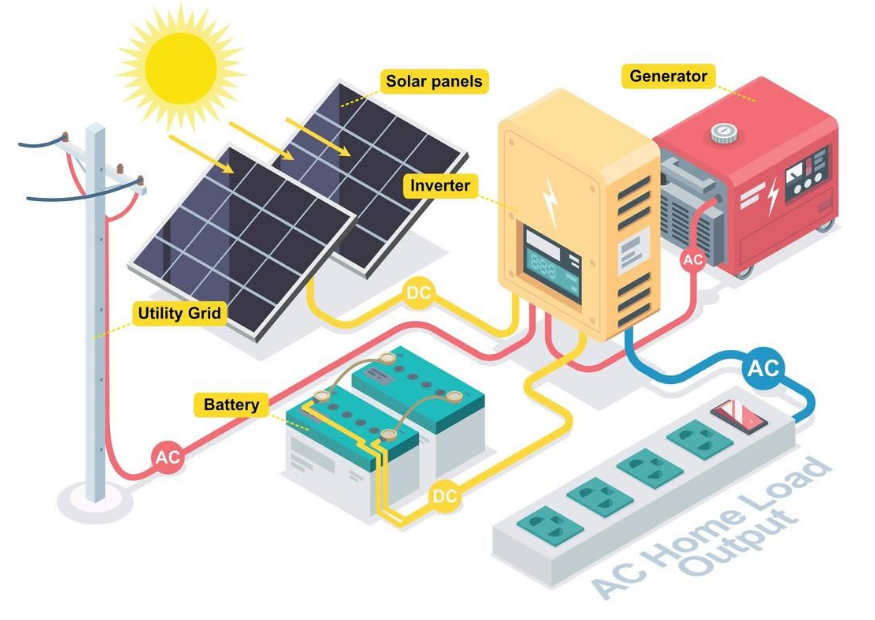
System Components
Solar Panels
Warranty: 25 years product & performance warranty.
Solar Inverter
Warranty: 5–10 years depending on brand.
Bi-Directional Meter
Net metering only — Dubai/Abu Dhabi
Current Transformers
Monitoring System
Mounting Structure
Who is On-Grid Solar Best For?
- Factories, warehouses & industrial facilities with heavy daytime operations.
- Free Zone commercial buildings (SAIF, RAKEZ, Hamriyah, Ajman FZ).
- Offices & retail running 8 AM–6 PM.
- Properties wanting the lowest upfront cost and fastest payback.
- Dubai & Abu Dhabi property owners wanting to maximise net metering credits.
Savings Potential
| S. No | Property Type | Bill Reduction | Payback |
|---|---|---|---|
| 1 | Industrial / Factory | 40–65% | @mdo |
| 2 | Jacob | Thornton | @fat |
| 3 | Larry | the Bird |
Get In Touch With Us
You may contact us via E-mail or complete our form, and we will contact you as soon as possible.